
Capacity Is Contracted. Capability Is the Constraint.
Philbert Shih opened infra/STRUCTURE 2026 by calling this moment the Interlude: the calm before the storm. Demand is proven. The capital is committed. What comes next is execution.
We spent three days in Las Vegas listening to the people building, financing and powering AI-scale infrastructure. The decks were about gigawatts, GPUs, rents and transformers. But almost every one of them, at some point, landed on the same thing: the work still has to be done by people. And the people are not scaling at the rate of the megawatts.
Here is what we took away, through the Innovorg lens and through my own.
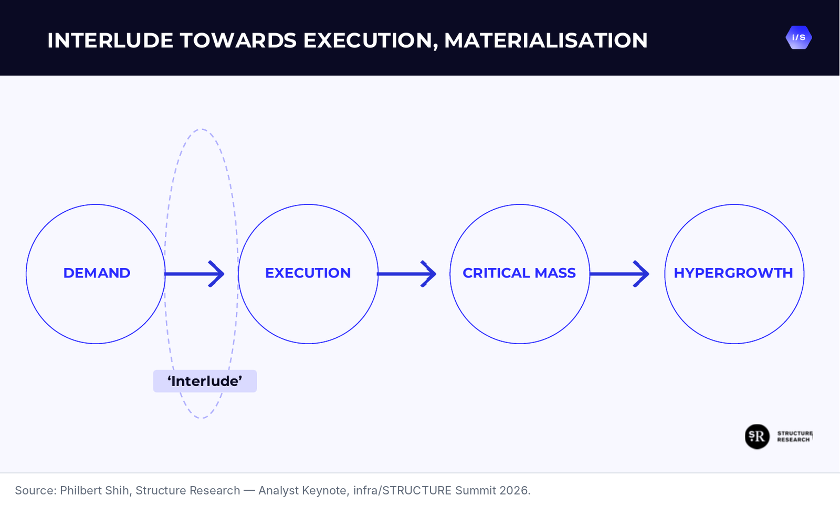
1. Demand isn’t the risk. Delivery is.
Structure Research put big-five capex at roughly $825bn this year and AI critical IT capacity growing from ~15 GW in 2025 to ~140 GW by 2030. The labs are already shopping for 2028. Supply for 2027 is spoken for.
So the question has moved from “is it real?” to “can we deliver it?” Foresight’s answer was sobering: 9 out of 10 data center projects are delivered late. One month of delay on a 60 MW project erodes about $14.2M in value and pulls IRR from 17.1% to 15.5%. Six months takes it to 8.8%.
The part that stayed with us: the industry blames power, permits and supply chains, but Oxford’s research points inward. Optimistic planning. Fragmented accountability. Poor sequencing. Weak real-time visibility. Foresight called the fix “the other iron triangle”: people, process and systems. And projects fail at their weakest link.
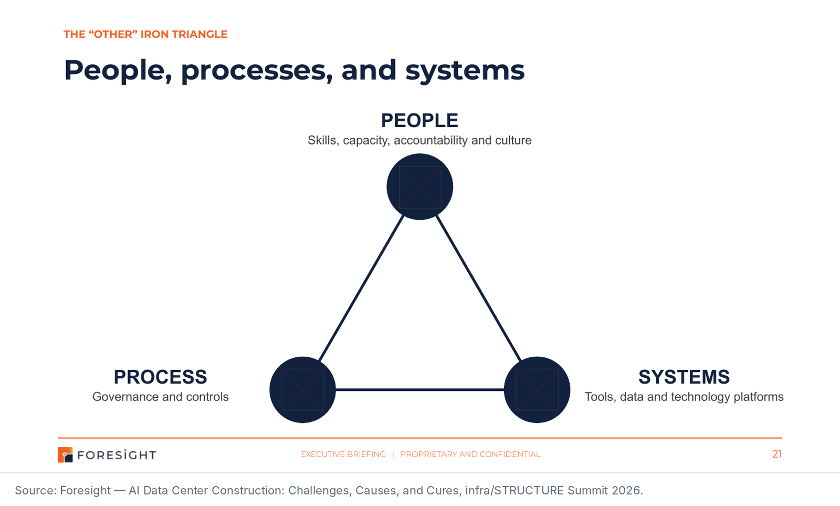
People is the leg of that triangle with the least instrumentation. Most operators can tell you their PUE to two decimals. Few can tell you, with the same rigor, whether the team commissioning next quarter’s hall is ready to do it.
2. Every megawatt is different now. So is every job.
Jabez made the point that the market can no longer be measured in MW alone. The same 1 MW hall yields roughly 5x more compute on Rubin than on Hopper. “Every megawatt will be different moving forward, depending on the hardware deployed within it.”
The Europe team showed the same curve from the facility side: H200 racks under 20 kW, GB200 at ~120 kW, Vera Rubin at ~200 kW, Rubin Ultra at 600–660 kW. A 5x jump in rack power in a single product cycle. Structure Research expects legacy air-cooled capacity to fall from 80%+ of the market today to 16% by 2031.
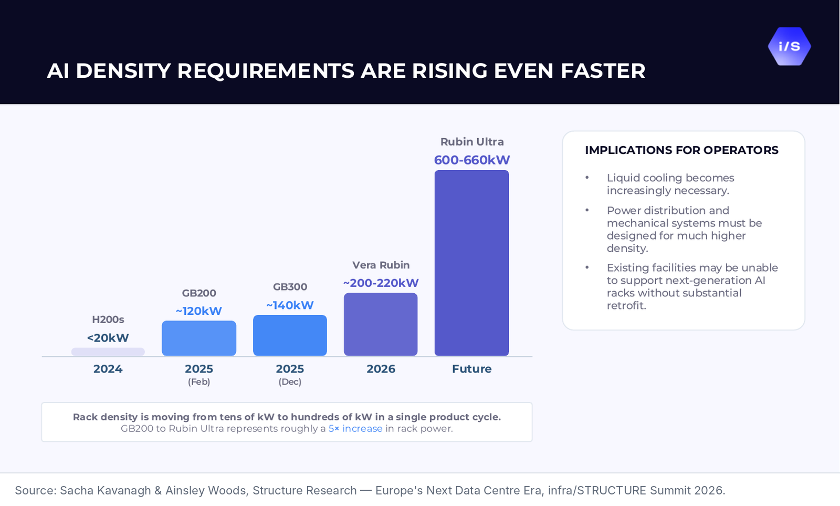
That is a facilities story. It is also a workforce story. The technician who ran a 10 kW air-cooled hall for a decade is now working on liquid loops, CDUs and power distribution that did not exist in their training. The skills half-life just collapsed. And the hall does not wait for the team to catch up.
If every megawatt is different, every role description written before 2024 needs a second look.
3. Growth is landing where the talent isn’t.
The new site-selection map has three tiers: metro, regional and remote. Tier 2 and Tier 3 locations that were not viable five years ago are now absorbing gigawatts. New Carlisle, Indiana. West Texas. Ellendale. Johor and Batam. Aragon. Swapna summed up India in one line: training chases power, not users.
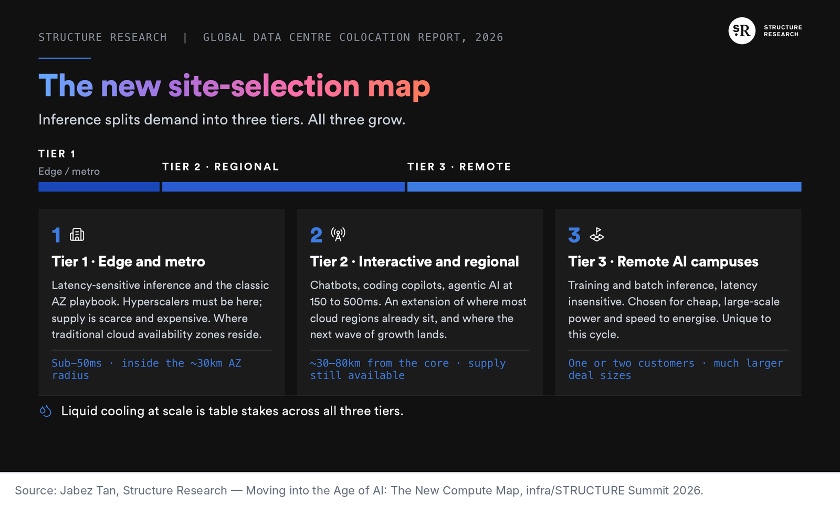
Power and land decide where the hall goes. They do not decide whether there is an experienced operations team within a hundred miles of it. Most of the time, there isn’t.
AlertOps put the gap in numbers: about 97 GW of new capacity between 2025 and 2030, 140,000 skilled workers needed by 2030, and construction cycles compressed from 36 months to 12. Foresight added a 439,000-worker shortfall in US construction alone.
You cannot hire your way out of that in a market that did not exist five years ago. Operators will have to build capability where the power is: redeploy proven people, onboard new ones faster, and know precisely who is ready for which site before it energizes.
4. Day 2 is where returns are won or lost.
The neocloud sessions had one message underneath the financing charts: racked GPUs don’t make money, running clouds do.
• hosted·ai: most GPU fleets run at 20–40% utilization, and too often it is “utilization nobody actually owns.”
• Penguin Solutions: AI infrastructure typically runs at ~55% efficiency. In a 10,000-GPU scenario, missed SLAs alone cost $36M a month. Their four truths from the SK Telecom Haein build: success is defined by Day 2 operations, the operating model matters as much as the design, requirements keep evolving, and operational excellence is the greatest competitive advantage.
• AlertOps, citing Uptime Institute: 87% of outages were preventable, and human procedural error climbed ten points year over year. “The failure mode is operational, not physical.”
We agree with all of it. And we would add one thing. Utilization has an owner now because someone decided to measure it. Workforce readiness needs the same treatment: a defined standard, measured continuously, owned by operations. Not a training record. A live view of capability against the work the site actually has to do.
5. The ops team of 2028 is people and agents.
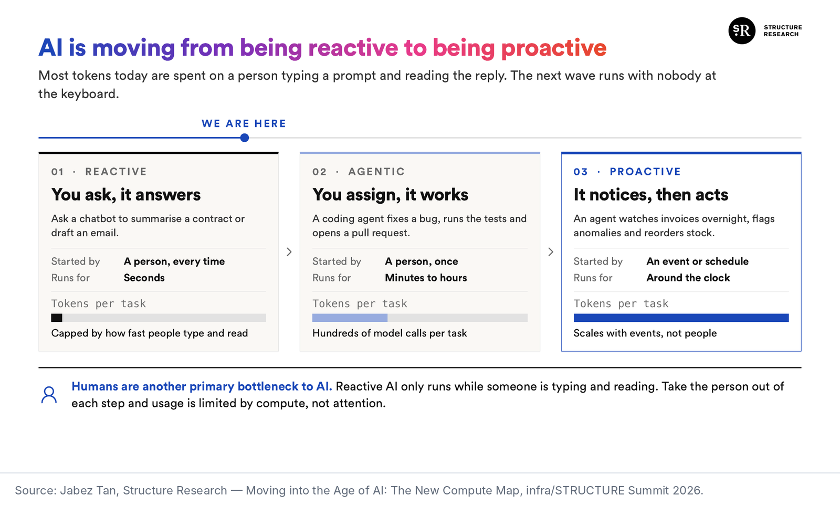
Jabez closed Day 1 with a slide we keep coming back to. AI is moving from reactive (you ask, it answers) to agentic (you assign, it works) to proactive (it notices, then acts). His line: “Humans are another primary bottleneck to AI.” Bots already pass humans in web traffic. Hyperscalers and neoclouds are designing infrastructure to be consumed by machines.
The same shift is reaching the operations floor. AlertOps showed AI reasoning agents handling alarm triage and root-cause suggestions, cutting 8.8 million raw events to under one million actionable alerts across 260+ facilities. Their goal: encode lessons learned “into the platform, not individual engineers.”
That raises a question nobody on stage fully answered. If an agent is doing first-line triage at 3 a.m., who decided it was ready? Against what standard? We think the answer has to be the same one used for the people beside it. One standard, applied to the whole workforce, human and digital.
My lens: I’ve seen this wave before
One of Phil’s slides mapped four waves: hosting, hyperscale and public cloud, neocloud, and hyperscale AI. “History is repeating itself again.” He listed what is different this time: crypto and finance founders instead of sysadmin founders, VC instead of credit cards, capital requirements and scaling pace nobody has seen before.
I started in wave one. Night shift, front-line support, at one of the first hosting companies. Over twenty years I watched that industry go from racks in a room to services teams running across continents.
What I would add to Phil’s list is what stays the same. Every wave was sold on hardware and capital. Every wave was won or lost on operations. And every wave hit the same wall: the build moved faster than the people who had to run it. In wave one we solved it by hand, one person and one shift at a time. That does not work at 140 GW.
The difference this time is that we can see it coming, and we can measure it.
What to do with the Interlude
Duos asked a simple question about the supply chain: what happens if your primary supplier disappears tomorrow? Ask it about your people. If the one engineer who knows your switchgear sequence leaves, who is qualified to step in? Do you know, or do you hope?
The Interlude is the window to answer that before the storm. Three moves we would make now:
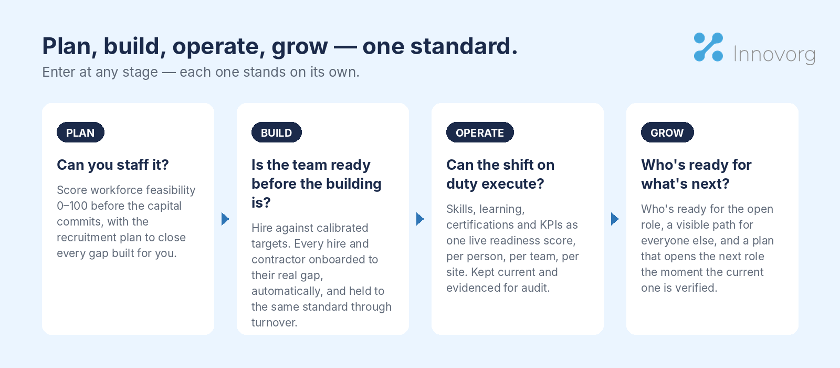
1. Set one standard for every stage. Plan, build, operate, grow. The same definition of “ready” from commissioning to steady state, so a site doesn’t reset its expectations every time it changes phase.
2. Measure capability, not headcount. Know who can do what, at which site, against the work coming in the next two quarters. Capacity is a number of people. Capability is whether the hall runs.
3. Treat readiness as a delivery risk. It belongs on the same dashboard as power, permits and transformer lead times, owned by the operations leader.
The megawatts are contracted. The capital is committed. Capability is the part still within our control. Workforce readiness, run like infrastructure.
Elya McCleave is Founder & CEO of Innovorg, the workforce intelligence platform for digital infrastructure operators. Read more on how Innovorg defines and measures workforce readiness: https://innovorg.com/what-is-workforce-readiness Innovorg was an Industry sponsor at infra/STRUCTURE 2026.
Sources
All figures are from the infra/STRUCTURE 2026 presentation decks (Wynn Las Vegas, October 6–8, 2026):
• Structure Research — Philbert Shih, Analyst Keynote: “Interlude … The Calm Before the Storm”
• Structure Research — Jabez Tan, AI Keynotes Day 1 (“The New Compute Map”) and Day 2 (“AI Infrastructure”)
• Structure Research — Sacha Kavanagh and Ainsley Woods, Europe; Swapna Subramani, India and the Middle East
• Foresight — “AI Data Center Construction: Challenges, Causes, and Cures”
• Penguin Solutions — “Three Paths to Neocloud Success”
• hosted·ai — “From Bare Metal to a Profitable Business in Hours”
• AlertOps — “Operating the Interlude” (cites CBRE, Synergy Research, Uptime Institute, IDC)
• Duos Technology Solutions — “Supply Chain Resilience in the Age of AI”